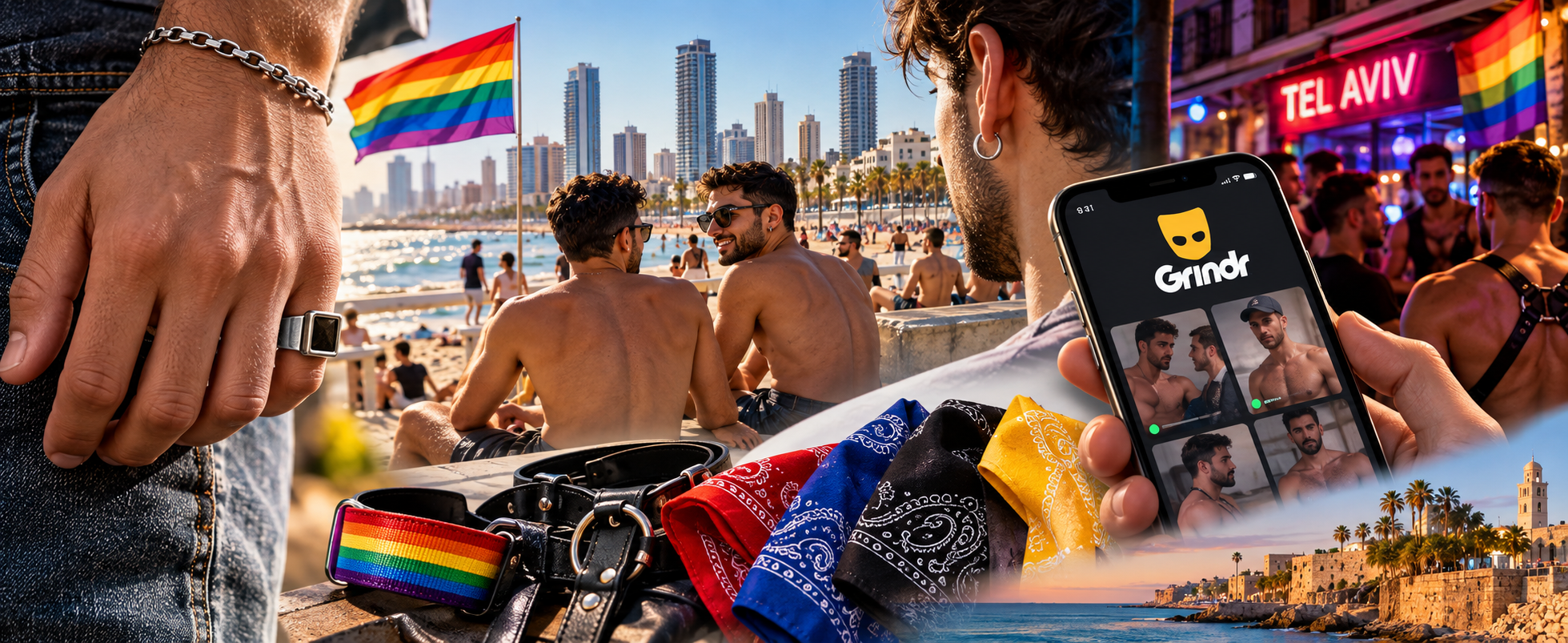
But how well do these signals actually work today?
It is especially interesting to look at the subject through the lens of Israel and Tel Aviv — a city where the LGBTQ+ community has a highly visible presence in urban culture, while the modern gay scene has long since moved beyond traditional “secret codes.”
The modern scene is not limited to bars and dating. It also includes a broad social, cultural, and community infrastructure.
Where Did Gay Codes Come From in the First Place?
Historically, the situation was much more complicated.
During periods when openly identifying as homosexual could lead to dismissal from work, family problems, social condemnation, or even criminal prosecution, men had to find ways to recognize “their own” without asking directly.
This led to the development of different forms of visual language.
Some people wore particular types of clothing. Others wore an earring. Some used a handkerchief of a specific color, while others wore a ring on a particular finger.
The main characteristic of this language was its ambiguity.
To an outsider, it could look like an ordinary piece of jewelry. To someone within the community, it could be a potential signal.
That is precisely what made these codes useful.
Pinky Rings: Are They Really a “Gay Sign”?
This is one of the most common questions.
The answer is: sometimes, but it is definitely not a universal sign.
Pinky rings have historically appeared among gay and queer men in different countries. They were a convenient signal precisely because they looked like completely ordinary jewelry.
A man could wear a pinky ring without having to explain its meaning to anyone.
However, it is important to understand that the claim that “a ring on the left pinky means gay, while a ring on the right pinky means active or passive” is not a universal rule.
There is no official or generally accepted standard of this kind in Israel either.
Today, a man in Tel Aviv may wear a pinky ring because:
- he likes a vintage style;
- he prefers masculine rings;
- it is a family piece of jewelry;
- it is simply part of his look;
- he likes minimalist aesthetics;
- or because he genuinely connects with the queer context associated with the jewelry.
For that reason, a ring can be considered a possible signal, but not proof.
Left Hand or Right Hand?
There are many charts online claiming things such as:
- “left — active”;
- “right — passive”;
- “left — gay”;
- “right — bi.”
These charts should be treated with caution.
Meanings like these did exist in certain communities, but there was never one international “gay alphabet” that worked in exactly the same way in New York, London, Tel Aviv, and Berlin.
So if you see a man in Tel Aviv wearing a ring on his right pinky, you cannot automatically conclude that he is signaling his sexual orientation or sexual role.
It is much more useful to look at the overall combination of signals.
The Earring: An Old Code That Has Mostly Lost Its Meaning
The story surrounding earrings is even more well known.
During the 1970s, 1980s, and 1990s, there was a popular stereotype that an earring in a particular ear could indicate membership in the gay community.
One of the best-known American versions was:
“Left is right, right is wrong.”
In other words, an earring in the right ear supposedly signaled that a man was gay.
But this was never a universal rule either.
Today, it is practically useless as a reliable indicator.
A young man in Tel Aviv with an earring in his right ear could be gay, bisexual, heterosexual, or simply someone who likes piercings.
Moreover, men’s earrings have become so common that they have largely lost their function as an identifier.
However, among certain age groups and subcultures, the aesthetic of an earring can still be associated with a queer look.
In other words, its meaning has shifted:
Then — a potential code; today — primarily a style element.
Bracelets and Rings
The modern situation with bracelets is even more interesting.
A rainbow bracelet is the most obvious example.
But not every man wearing a rainbow bracelet necessarily wants to announce his sexual orientation. Sometimes it simply represents support for the LGBTQ+ community.
Another possibility is thin silver or leather bracelets.
In some queer male subcultures, a particular combination of accessories can create a recognizable look: a bracelet, ring, chain, earring, beard, and a specific clothing style.
At this point, however, we are no longer talking about a “code” in the traditional sense.
It is more of an aesthetic language.
Hanky Code: Does It Exist in Israel?
Yes. The hanky code is known throughout international gay culture.
The classic system used colored handkerchiefs as a sexual language. Certain colors were historically associated with specific sexual practices or interests.
But there is an important qualification.
Even in places where the hanky code is actually used, the meanings of colors can vary.
In addition, the classic system also involved the location of the handkerchief:
Left side — one meaning, right side — another.
That is precisely what made the hanky code so famous.
However, in modern Tel Aviv, you cannot simply see a handkerchief and consult a universal chart to determine someone’s sexual preferences with certainty.
Today, the hanky code is primarily part of certain Fetish, BDSM, and Leather subcultures rather than a universal language used by all gay men.
If someone is wearing an ordinary blue or black handkerchief, that does not automatically mean they are using any kind of sexual code.
What Actually Works Today?
This is where the major transition from the past to the present takes place.
Instead of a secret language of clothing, the modern gay community increasingly relies on context.
For example:
- where the person is;
- who they are interacting with;
- what event they came to;
- what is written in their profile;
- what photographs they post;
- which pronouns or identifiers they use;
- how they describe themselves;
- whether they are in a queer space.
This is especially noticeable in Tel Aviv.
The city’s gay scene is spread across different neighborhoods and venues, and even mainstream bars and clubs may host queer events and parties.
As a result, a man sitting in an ordinary café may be gay without displaying any visual code at all.
Conversely, someone at a queer party may look completely “straight.”
Hilton Beach as a Social Signal
There are places where the context itself becomes a signal.
Hilton Beach has long been associated with Tel Aviv’s LGBTQ+ community and is considered one of the city’s best-known queer spaces.
And this creates an important distinction from a ring.
If a man is at a beach associated with the LGBTQ+ community, interacting with other men and participating in the social atmosphere of the place, the context may be much more informative than an earring or a ring.
But even here, it is impossible to automatically draw conclusions about a specific individual.
He could be a friend, a tourist, an ally, or simply someone who enjoys the beach.
Tel Aviv After 2024–2025
The modern scene cannot be examined separately from the events of recent years.
In June 2026, Tel Aviv once again held its Pride Parade. The event marked the return of a major public celebration after a two-year break.
This demonstrates that queer culture in Israel continues to exist not only within closed communities, but also in public space.
At the same time, issues of safety and privacy remain important for some members of the community.
Grindr: The New Gay Code Instead of the Handkerchief
If the old gay code could be described as:
ring → earring → handkerchief → clothing,
the modern version looks more like:
profile → photo → bio → preferences → distance → message.
Grindr has become one of the best-known digital platforms for men seeking connections with other men.
And this is where entirely new “codes” appear.
- Top / Bottom / Vers — sexual roles or preferences;
- Masc / Fem — a description of appearance or gender presentation;
- Bear — identification with or interest in the Bear community;
- DL / Discreet — a desire to remain discreet;
- LTR — looking for a long-term relationship;
- NSA — no-strings-attached encounters.
These labels are much more informative than a pinky ring.
But they are not absolute either. A person may use a particular word in their profile and give it their own personal meaning.
The Particular Role of Grindr in Israel
In Israel, the app plays a role similar to the one it plays in other major cities: it allows people to meet without first having to go to a bar or party.
But geolocation creates both convenience and risk.
When the app displays users who are nearby, the distance shown can potentially give other people an approximate idea of someone’s location.
For this reason, digital privacy has become an important part of modern dating culture.
It is not advisable to publish a home address, exact workplace, or other sensitive information. Before meeting someone in person, it is sensible to communicate first and choose a public place for the meeting.
Bear, Leather, and the Fetish Scene
Within specialized communities, older codes have survived to a greater extent.
You may encounter:
- leather clothing;
- harnesses;
- distinctive accessories;
- paw-print symbols;
- Bear flags;
- the hanky code;
- specialized jewelry.
However, a person’s appearance should not automatically be interpreted as an indication of their sexual role or preferences.
Leather can simply be fashion.
A harness can simply be part of a club look.
A beard does not necessarily mean Bear.
A ring does not mean Top.
The color black does not mean BDSM.
This is a very important principle in the modern queer context.
How Can You Tell Today That a Man May Be Gay?
Looking at the subject practically, there are several levels of signals.
Level 1 — Jewelry.
A pinky ring, earring, bracelet, or chain.
These are weak signals.
Level 2 — Style.
A particular queer or fashion aesthetic, rainbow elements, or Bear, Leather, or Fetish elements.
This is more noticeable, but it is still not proof.
Level 3 — Location.
A queer bar, Pride event, LGBTQ+ center, specialized party, or well-known queer space.
The context becomes more meaningful.
Level 4 — Digital Profile.
Grindr, Scruff, or another dating service for men, or a profile that clearly states a person’s sexual orientation or preferences.
This is a much more direct signal.
Level 5 — Direct Communication.
The most reliable approach is when the person themselves talks about their sexual orientation or expresses mutual interest in a man.
So What Does a Ring on the Right Pinky Mean in Tel Aviv?
If we return to the original question, the answer is fairly simple:
A ring on the right pinky in modern Tel Aviv is not an established code meaning “I am gay.”
However, it can be part of a queer aesthetic.
If there are additional signals at the same time — for example, a particular style, a queer event, interaction with men, a dating-app profile, or an openly expressed interest in men — then the ring may be perceived as an additional signal, but not as an independent one.
This is exactly why modern gay codes have become much more flexible.
In the past, you almost needed a “dictionary”:
handkerchief color + side + earring + clothing.
Today, it is more about:
context + profile + style + behavior + communication.
The Main Takeaway
Tel Aviv’s gay culture in 2026 no longer operates according to one unified secret code.
- Pinky ring — not a guaranteed gay signal.
- Right or left hand — not a universal system of sexual roles.
- Earring — has largely lost its function as an identifier.
- Bracelet — usually an accessory or an openly supportive Pride signal.
- Hanky Code — survives mainly within specialized Fetish, Leather, and BDSM communities.
- Queer style — can be a signal, but it is not proof.
- Grindr — a much more direct way to communicate sexual orientation and preferences.
And the most interesting change is that the modern gay code is no longer purely visual.
It has become social and digital.
A pinky ring may make another man wonder: “I wonder if he is gay too?”
But a Grindr profile, participation in Pride, visiting a queer space, or openly meeting another man provides a completely different level of information.
And that is precisely the difference between the old and the new gay code: in the past, you had to know how to read symbols; today, you much more often need to know how to read the context.