Let’s be honest.
Have you ever looked at a photo of another gay man and immediately started comparing yourself to him?
His body looks better. His skin is smoother. His muscles are bigger. His waist is smaller. His hair is perfect. His life seems more exciting. And suddenly, you start noticing everything you don’t like about yourself.
Maybe you think you should lose a few kilos. Maybe you need to spend more time at the gym. Perhaps you should change your hairstyle, buy better clothes, or finally do something about that part of your body you’ve never really liked.
Sound familiar? You’re certainly not alone.
Body image is a complicated subject in gay culture. For many gay men, appearance can feel like more than just a personal preference. It can become a measure of attractiveness, social acceptance, romantic opportunities and even self-worth.
But why do so many of us feel that we have to look perfect? And more importantly, who decided what perfect actually looks like?
The Pressure to Have the Perfect Gay Body
Open Instagram, scroll through a dating app, or look at photos from a popular gay beach party.
You will probably notice a familiar aesthetic: muscular bodies, defined abs, broad shoulders, smooth skin, fashionable clothes and carefully selected photographs.
Of course, there is absolutely nothing wrong with being fit, enjoying fashion, going to the gym or taking pride in your appearance.
The problem begins when one particular body type becomes the standard against which everyone measures themselves.
Somewhere along the way, the idea of the perfect gay body became associated with being young, muscular, slim, attractive and seemingly flawless.
And if you don’t fit that image, you may start feeling that you’re somehow less desirable.
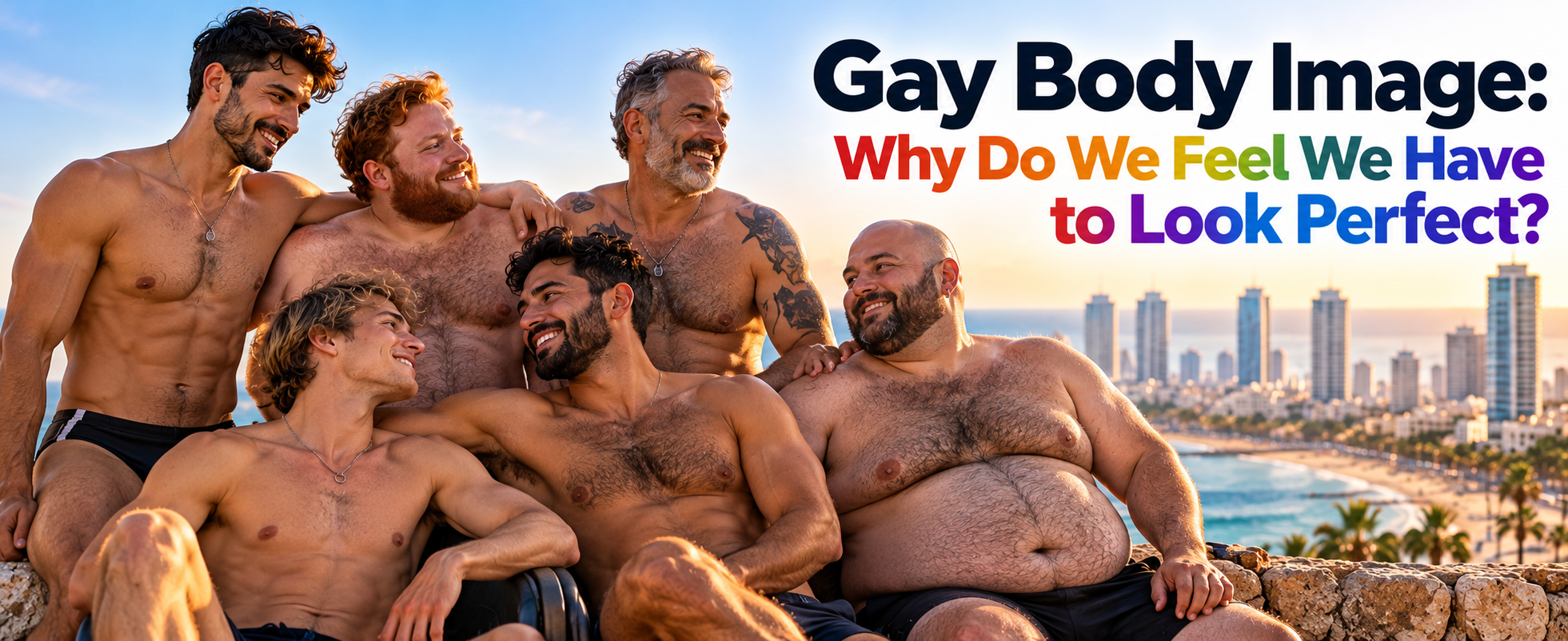
But gay men come in every shape and size.
Tall, short, skinny, muscular, chubby, hairy, smooth, young, older, athletic and everything in between.
There is no single body type that represents the entire gay community.
Yet the pressure to fit into one particular image can be surprisingly powerful.
1. Social Media: Living in a World of Perfect Bodies
Instagram and other social platforms have changed the way we see ourselves.
We are constantly exposed to carefully selected images of people who seem to have everything: perfect bodies, beautiful apartments, exciting holidays, successful careers and seemingly effortless social lives. But what we see is rarely the complete picture.
A photograph may involve carefully chosen lighting, flattering angles, professional editing, filters, multiple attempts and hours of preparation. We compare our everyday reality with someone else’s best-selected moments. And this comparison can make us feel inadequate. The problem isn’t necessarily that other people look good. The problem is when their appearance becomes the reason we dislike our own.
Your body is not supposed to compete with somebody else’s Instagram profile.
2. Dating Apps and the Culture of Instant Judgment
Dating apps have made meeting people easier in many ways.
But they have also created an environment where appearance is often the first thing people notice. A photograph appears. You look. You swipe.
Someone likes you. Someone ignores you. Someone blocks you. Someone sends a compliment. Someone makes a comment about your weight or appearance. In a matter of seconds, you can feel attractive, rejected, wanted or completely invisible. And when this happens repeatedly, it can become easy to connect your self-worth with the number of messages, matches or likes you receive.
Some dating profiles openly describe very specific physical preferences. Others use coded language to communicate which body types they consider acceptable. Preferences are personal, and nobody is obligated to be attracted to everyone. But there is a difference between having preferences and making other people feel inferior because they don’t fit them. You are allowed to have standards. Other people are allowed to have preferences. But nobody deserves to be humiliated because of their body.
3. The Gym: Health, Confidence or an Endless Competition?
Going to the gym can be a wonderful thing. Exercise can help you feel stronger, improve your fitness and give you more confidence. For many people, working out is an important part of a healthy lifestyle. But sometimes the motivation changes. Instead of exercising because you enjoy it, you start exercising because you hate the way you look. You don’t go to the gym because you want to become stronger. You go because you are afraid of becoming less attractive.
You don’t enjoy your progress because every improvement reveals another imperfection. Your chest isn’t big enough. Your abs aren’t defined enough. Your arms aren’t muscular enough. There is always another goal, another body to compare yourself with and another reason to feel that you haven’t done enough. Fitness should be something that adds value to your life, not something that makes you feel like you’re constantly failing.
You can want to improve your body without hating the body you have today.
4. The Fear of Getting Older
Age is another complicated subject in gay culture. Some men feel that their social and romantic value is strongly connected to youth. When you’re younger, you may feel pressure to have the perfect body.
When you get older, you may start worrying about wrinkles, grey hair, changing skin, losing muscle or becoming less visible. You might find yourself comparing your current appearance with photographs from ten or fifteen years ago. And suddenly, getting older feels like losing something. But aging isn’t a failure. Your body changes because you live.
You gain experience. You build relationships. You make mistakes. You discover who you are. You change your priorities. There is something deeply unfair about living in constant fear of losing your youth instead of enjoying the life you have now. You don’t become less worthy of love because you are getting older. And you certainly don’t need to look 25 forever.
5. The Different Standards Within the Gay Community
It is important to recognize that body image pressure doesn’t affect everyone in the same way. Some men experience pressure to be muscular. Others feel pressure to be thin.
Some feel judged because they are hairy, while others feel uncomfortable because they are not.
Men with disabilities, men of different racial backgrounds, transgender men and gender-diverse people may encounter additional expectations or exclusion related to appearance and identity.
Even within gay culture, different social circles can have very different ideas about attractiveness. The problem is not that people have different tastes. Diversity in attraction is completely normal.
The problem is when a narrow beauty standard becomes a rule that determines who deserves attention, respect or acceptance.
There is room in our community for every body. Not as an exception. Not as a special category. Simply as part of who we are.
6. When Compliments Become Another Form of Pressure
Compliments are usually intended to make someone feel good. But sometimes even positive comments can reinforce unrealistic expectations.
Think about how often people say things like:
“You look amazing! Have you lost weight?” “Wow, you’ve got so muscular!” “You look so much better than before!”
Although these comments may be well-intentioned, they can create the impression that a person’s body is constantly being evaluated.
And what happens when you gain weight again? What happens when you stop working out? What happens when your appearance changes?
Do you suddenly become less worthy of compliments? Our value shouldn’t depend on whether our bodies meet somebody else’s expectations. Sometimes the best compliment has nothing to do with appearance. “You make me feel comfortable.” “I love spending time with you.” “You always make me laugh.” “I feel like I can be myself around you.”
These are the kinds of things that build connections beyond physical attraction.
7. Are We Looking for Love or Approval?
This is perhaps the most important question. Sometimes we say we want to look better because we want to feel more confident. But underneath that desire, there may be another expectation: If I become more attractive, more people will want me. If more people want me, I’ll feel accepted. If I feel accepted, maybe I’ll finally feel good about myself.
The problem is that external approval can become an endless cycle. You receive attention, feel good for a while, and then need more. You get compliments, but start worrying about whether they will continue. You meet someone attractive, but wonder whether you’re good enough for them. And instead of enjoying a connection, you find yourself constantly evaluating your own appearance. Being desired can feel wonderful. But being desired is not the same as being valued. You deserve relationships in which your personality, humor, kindness, intelligence, vulnerability and individuality matter too.
8. Learning to Feel Comfortable in Your Own Body
Changing the way you see yourself doesn’t happen overnight. And you don’t need to suddenly fall in love with every part of your appearance. Start with something simpler: stop treating your body like an enemy. Here are a few small steps that may help.
Stop comparing yourself with every photograph you see.
Remember that social media is a collection of selected moments, not a complete representation of someone’s life.
Follow people with different body types.
Make your social media feed more diverse. Don’t surround yourself exclusively with one narrow image of attractiveness.
Exercise for yourself.
Choose physical activities that make you feel good, stronger and healthier rather than punishing yourself for how you look.
Wear clothes that make you comfortable.
You don’t need to hide your body until it reaches some imaginary ideal.
Pay attention to how people treat you.
Spend time with people who make you feel accepted rather than people who constantly criticize your appearance.
Learn to accept compliments.
You don’t have to argue with someone who tells you that you look good. And remember that you don’t have to earn the right to feel comfortable in your own skin.
9. The Community We Should Be Building
Imagine a gay community where you don’t feel that you have to look a certain way before entering a room.
Where a social event isn’t an invisible competition. Where people can meet without worrying about whether their bodies are attractive enough. Where older men aren’t automatically overlooked. Where bigger bodies aren’t treated as something to apologize for. Where people can be different without being made to feel inferior.
Wouldn’t that be a better community? We often talk about acceptance, diversity, equality and inclusion. But these values should exist within our own community too. We cannot ask the world to accept us while making other people feel that they don’t belong because of their appearance. Real inclusion means making space for people who don’t fit the stereotype. And that starts with the way we treat each other.
10. You Don’t Have to Be Perfect to Be Loved
Let’s return to the original question. Why do we feel that we have to look perfect?
Perhaps because we live in a culture that constantly tells us that being attractive means being valuable. Perhaps because dating apps turn people into photographs. Perhaps because social media makes comparison almost unavoidable. Perhaps because many of us grew up feeling different and learned to seek acceptance through the things we could control, including our appearance. Whatever the reason, it is worth questioning the standards we have learned to accept.
You can enjoy going to the gym. You can care about your appearance. You can want to change something about your body. You can have preferences. But none of those things should make you believe that you’re not good enough as you are. You don’t need perfect abs to deserve affection. You don’t need a perfect face to be attractive. You don’t need to be young forever to be desirable. And you don’t need to look like someone else to belong.
A Final Thought: Your Body Is Not Your Entire Identity
The gay community is made up of people, not photographs.
People with stories, dreams, fears, humor, talents, experiences and imperfections.
Some are muscular. Some are skinny. Some are bigger. Some are older. Some are young. Some love the gym. Others would rather spend their free time reading a book, watching a movie or meeting friends for coffee.
All of them deserve to feel welcome.
Maybe it’s time to stop asking ourselves whether our bodies are good enough for the gay community.
And start asking whether our community is doing enough to make everyone feel welcome.
Because real confidence isn’t about having the perfect body.
It’s about being able to walk into a room, look in the mirror and know that you don’t have to apologize for being yourself.
You are more than your body. And you always have been.
GAYIL — A Community Beyond Appearances
At GAYIL, we believe LGBTQ+ community is about people, experiences, connections and belonging.
Discover events, places and communities across Israel. Meet people who share your interests, explore new experiences and find spaces where you can be yourself.
You don’t have to fit a stereotype to belong.
Live. Connect. Belong.
A Note on Body Image and Mental Well-being
If concerns about your appearance are taking over your daily life, affecting your relationships or making it difficult to feel comfortable in your own body, consider talking to a qualified mental health professional. You don’t have to deal with these feelings alone, and asking for support is a sign of strength.