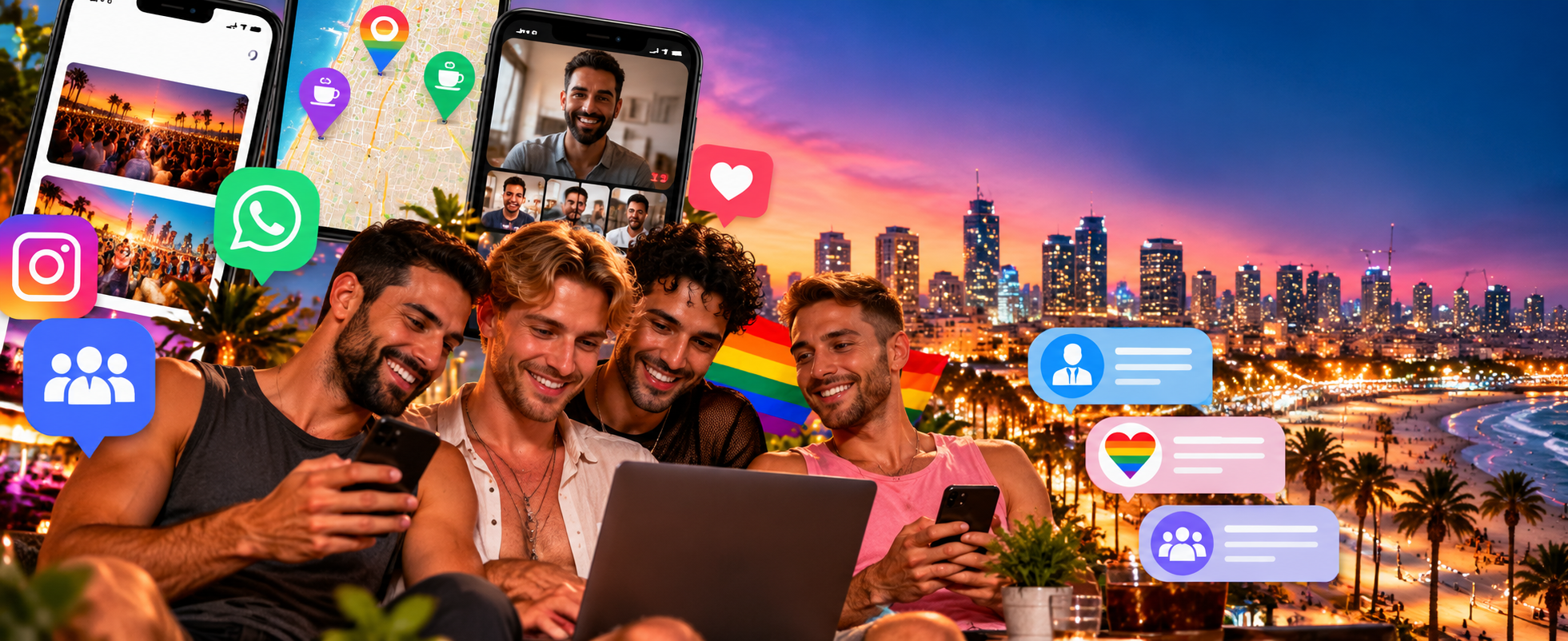
Why Gay Community Still Matters in the Age of Apps
Today, finding another gay man can take just a few seconds. Open an app, enable location services, and see who is nearby. Meeting someone, exchanging messages, arranging a date—all of this has become easier than ever.
But if technology has made meeting people so accessible, why do so many people still feel lonely? Why can hundreds of conversations fail to create a genuine sense of belonging? And why do we still need gay communities, community centers, events, bars, and local groups when almost everything seems available on our phones?
The answer is simple: being able to find someone is not the same as finding your community.
From Random Encounters to Endless Choices
Apps have changed the way gay men meet, build relationships, and explore their sexuality. They help people connect regardless of their city, age, or social circle. For someone living in a small town, moving to Israel, or not yet feeling ready to talk openly about their sexual orientation, the digital world can become the first window into gay life.
That is a genuinely important opportunity.
In the past, meeting other gay men could depend on circumstances: knowing the right bar, having friends already connected to the community, or finding the courage to attend an event alone. Today, you can take that first step from home.
But this accessibility has another side.
When the choices seem endless, meeting people can turn into a constant search for something better. One profile replaces another, conversations end without explanation, and a potential meeting gets postponed in favor of the next match. A person can be constantly connected and still feel lonely.
The problem is not the apps themselves. They help people find one another. The real question is what happens after the introduction and what role these interactions play in our lives.
Community Is More Than Dating
Gay community is often associated with bars, nightclubs, parties, and dating apps. But that picture is incomplete.
Community means having people to go to the movies with, discuss a new music album, play sports, celebrate holidays, travel together, or simply have coffee after a difficult day at work.
It means having a place where you can show up not to find a partner, but simply because you feel good there.
It means meeting people who understand certain parts of your experience without having to explain everything from the beginning.
It also means connections between generations. People who have been living openly for years can share their experiences with those who are just starting their journey. Younger members bring new ideas, cultural interests, and ways of connecting.
These relationships do not all have to become close friendships. Sometimes it is enough to know that there are people in your city around whom you can feel comfortable being yourself.
A sense of belonging comes not only from the people you know, but also from the places where you can be yourself.
Why Offline Life Still Matters
Digital communication is convenient, but it cannot fully replace being together in person.
Sharing a laugh around a table, talking after a concert, meeting someone at a community event, dancing with friends, or running into someone at your favorite café creates a different kind of connection. There are tones of voice, gestures, shared experiences, and small moments that are difficult to convey in a message.
Offline spaces also allow us to see the diversity within the community. On apps, we often encounter a system of profiles and photographs where first impressions form quickly. At an event or community center, someone can reveal other sides of themselves through their humor, interests, ideas, actions, and the way they treat others.
And, of course, not everyone is looking for a romantic or sexual relationship.
Some people want to make friends. Others are looking for an interest group. Some want cultural events, sports activities, or opportunities to participate in community life. Others simply want to spend an evening in a place where they do not have to worry about how people might react to their sexual orientation.
That is why access to LGBTQ+ spaces matters not only for dating, but also for a full and meaningful social life.
Why Community Matters in Israel
In Israel, LGBTQ+ life is not limited to Tel Aviv. People live in Haifa, Jerusalem, Be’er Sheva, Ramat Gan, Petah Tikva, Rehovot, and dozens of other cities. Each place may have its own groups, initiatives, cultural events, and social circles.
However, finding out about them is not always easy.
Someone can live in the same city for years without knowing that there is an LGBTQ+ center nearby, that a group for a particular age range meets regularly, or that events are organized for new immigrants.
It can be especially difficult for people who have recently moved to Israel. Alongside adapting to a new country, they have to learn the language, find work, build a social circle, and become familiar with local culture. For some, meeting people who speak their native language and understand their experiences becomes an important part of feeling at home.
This is where technology can make a positive difference: not by replacing real-life connections, but by helping people find them.
A website, event calendar, map of LGBTQ+-friendly places, or directory of local communities can become the first step toward discovering life in a new city. People can find out where to go, how to get started, and what opportunities exist beyond their usual social circle.
Not Everyone Wants to Live on Apps
It is also important to remember that everyone experiences community differently.
Some people enjoy apps and find it easy to meet others online. Some quickly grow tired of endless messaging. Others prefer meeting people in person. And some deliberately limit their digital interactions because they do not want their social lives to become another task demanding constant attention.
None of these approaches makes someone more or less gay.
Participation in a community should not be measured by the number of contacts, followers, parties attended, or people met through an app. There is no single correct way to be part of the LGBTQ+ community.
Some people feel most at home in nightlife. Others prefer art, volunteering, sports, literature, or small gatherings with friends. Some find close connections at a community center, while others discover them through a book club or a local initiative.
The real diversity of a community lies in its ability to make room for many different kinds of people.
Technology Should Help Us Meet
It would be a mistake to set apps against real-life communities. Digital tools can be incredibly useful: they help spread information, connect people with shared interests, provide support, and make events visible that might otherwise go unnoticed.
The problem does not arise when we use technology. It arises when digital searching becomes our only way of interacting with the world around us.
Imagine an app helping you discover a concert. At the concert, you meet someone who later joins you at an exhibition. Through that person, you learn about a sports group, where you meet new friends. Gradually, random encounters become a social circle, shared routines, and common memories.
In this scenario, technology has fulfilled its best purpose: it has helped real connections emerge and grow.
That is the approach that can make digital community infrastructure genuinely valuable.
The Future of Gay Community Is Not Only Online or Offline
The future of LGBTQ+ life does not require abandoning apps and returning to the way people met decades ago. It requires more choices.
We need convenient digital tools that help people discover events, places, communities, and opportunities. But we also need spaces for in-person meetings, cultural initiatives, peer-support groups, and events where people can participate in community life without feeling that they must find a partner.
We need major celebrations and small gatherings. Digital channels and real-world venues. The option to remain anonymous and the opportunity to gradually become part of a community when someone feels ready.
Gay community still matters not because apps do not work, but because human connection is much broader than meeting someone.
We need more than people we can message. We need people with whom we can share our lives.
GAYIL: From the Screen to Real Life
That is why GAYIL is being built as one place to discover LGBTQ+ events, places, and communities across Israel.
Our goal is to help people see just how diverse LGBTQ+ life is throughout the country and make it easier to find opportunities to participate.
We want people to discover an event in a nearby city, find a welcoming venue, explore a local initiative, or connect with a community they did not even know existed.
GAYIL is not a dating website. It is a platform designed to help people navigate community life and discover opportunities for meaningful, real-world connections.
Because gay life is about much more than profiles and messages. It is music, culture, friendship, sports, family, art, community initiatives, celebrations, and ordinary days made better by the people around us.
Apps can help us find each other.
But we are the ones who build community.
GAYIL — Live. Connect. Belong.
Events. Places. Communities.