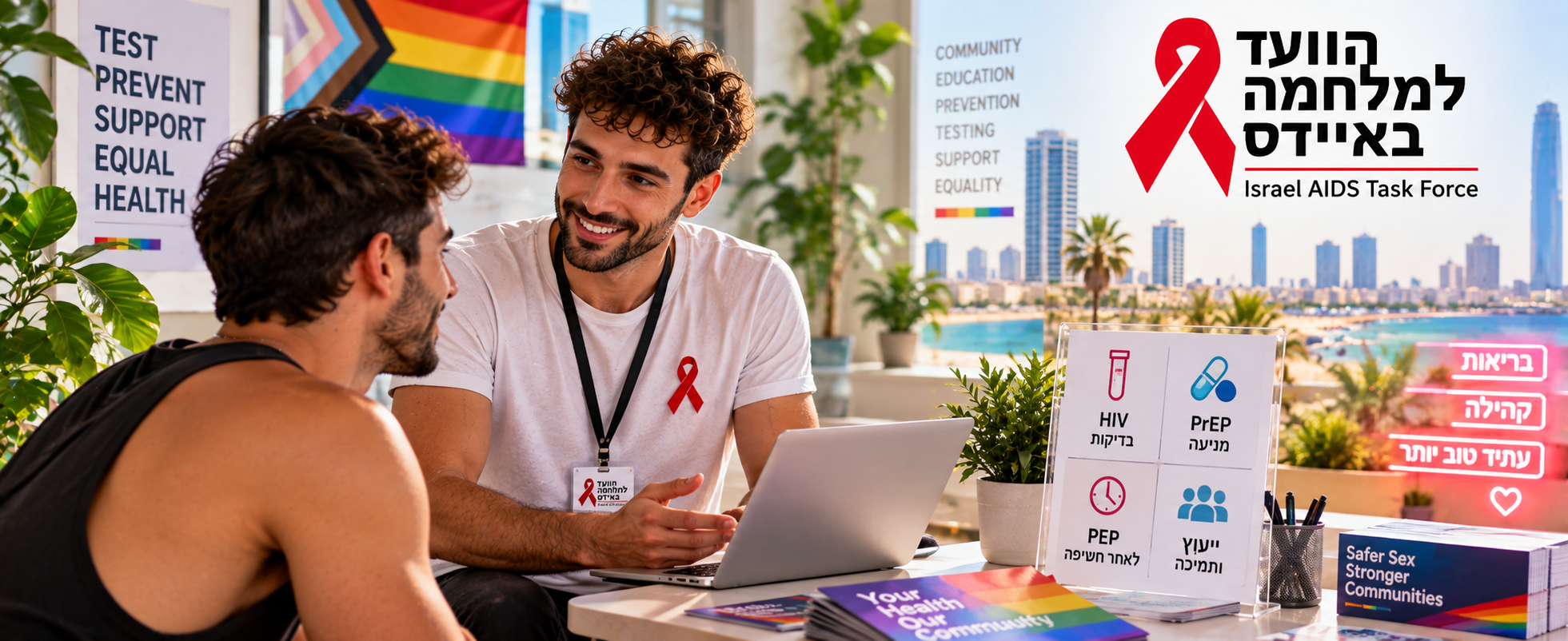
Israel AIDS Task Force: Where to Go for HIV Testing, Consultation, and Support in Israel
When it comes to HIV, many people still experience fear, embarrassment, or simply do not know where to turn.
Who can you ask after unprotected sex? Where can you get tested? Can the test be anonymous? What should you do if a risky encounter happened several days ago? Where can you get PrEP or PEP? What happens if the result is positive?
In Israel, one of the organizations that has been addressing all of these issues for decades is הוועד למלחמה באיידס — the Israel AIDS Task Force.
The organization was founded in 1985. Initially, its mission was to combat the spread of the AIDS epidemic and support people living with HIV. Today, its work is much broader: it focuses on HIV and STI prevention, counseling, testing, education, combating stigma, and supporting people living with HIV.
For Israel’s LGBTQ+ community, this is a particularly important resource because you do not have to wait until there is already a problem before reaching out.
Sometimes, simply asking a question is enough.
What Is the Israel AIDS Task Force?
The organization’s name literally means “Committee for the Fight Against AIDS,” but its modern activities extend far beyond AIDS itself.
On its official website, the Israel AIDS Task Force describes itself as an organization working with different groups throughout Israel in the field of sexual health. Its work takes place in communities, digital environments, schools, apps, and the media. The organization describes its goal as providing professional, accessible, and up-to-date assistance to people regardless of age, identity, or background.
The organization’s website highlights several major areas:
HIV and AIDS information, prevention, PrEP, PEP, testing, support for people living with HIV, counseling, youth programs, and education.
In other words, the Israel AIDS Task Force is not simply a place where you can get a blood test.
It is also an information, counseling, and community resource.
Why Go There If You Simply Want to Get Tested?
The simplest reason is to stop wondering.
HIV and many other sexually transmitted infections can remain without obvious symptoms for a long time. The Israel AIDS Task Force emphasizes that testing can help eliminate uncertainty and allow people to take care of both their own health and the health of their partners. The organization offers testing in a discreet and, in some cases, anonymous setting.
This is particularly important for people who:
- have had sex without a condom;
- have a new partner;
- have multiple partners;
- experienced a condom break;
- do not know their partner’s status;
- have symptoms that may be related to an STI;
- or simply feel that enough time has passed since an encounter and want reassurance.
Testing should not be viewed as punishment for having a sex life. It is simply a normal part of taking care of your health.
What Types of Tests Are Available?
It is important to understand that “getting an HIV test” and “getting tested for infections” are not exactly the same thing.
The Israel AIDS Task Force’s materials list different types of tests depending on the infection and the type of sexual contact. Blood tests are used for HIV and syphilis. Urine tests and PCR swabs may be used for chlamydia and gonorrhea, including samples from the throat, rectum, or genitals, depending on the type of contact.
This is particularly important for men who have sex with men, because an infection may be present outside the genital area.
For example, if oral sex took place, one set of tests may be relevant.
If anal sex took place, rectal swabs may be necessary.
That is why, when visiting a clinic, it is useful to be honest with the healthcare professional about the types of sexual contact that occurred. This is not a reason for judgment or criticism — the information is needed to determine which tests are appropriate.
Where Can You Get Tested Through the Israel AIDS Task Force?
The organization’s official website publishes a list of testing centers throughout Israel. It specifies which centers operate anonymously, which require identification, and which have their own conditions and schedules. The organization explicitly warns that opening hours and requirements at individual locations may change, so it is recommended to contact the center before visiting.
Anonymous Testing Center in Tel Aviv
Address: 29A HaNatziv Street, 3rd floor, Tel Aviv
Hours: Sunday–Thursday, 5:00–7:30 PM
Rapid testing is available until 7:00 PM.
Phone: 03-5613000 — the number listed on the testing-center page.
The Israeli Ministry of Health also lists this center as one of the testing locations associated with the Israel AIDS Task Force. The Ministry confirms that the initial test at this center is anonymous; if the result is positive, identification is required for the confirmatory test.
LGBTQ+ Community Testing Center
The Israel AIDS Task Force also works together with the Levinsky Clinic to provide testing at the LGBTQ+ Center in Gan Meir, Tel Aviv.
The organization’s current page states:
Sunday, 5:00–7:00 PM
Rapid testing is available until 6:30 PM. All tests are free of charge, except for the rapid test, which costs ₪120 and is subsidized by the LGBTQ+ Center.
This is a particularly convenient option for people who prefer to be tested in a space specifically oriented toward the LGBTQ+ community.
What About Other Cities?
The Israel AIDS Task Force lists testing locations in Tel Aviv, Beersheba, Haifa and the north, central Israel, and Jerusalem. These include medical centers and specialized clinics.
For example, the organization’s current list includes:
Haifa: Rambam and Merkaz Refui HaParsים
Beersheba: Soroka
Ramat Gan: Sheba
Rehovot: Kaplan
Kfar Saba: Meir
Afula: HaEmek
Jerusalem: Open House and Hadassah Ein Kerem.
There are also other government testing options. The Israeli Ministry of Health publishes an official list of recognized HIV diagnostic centers. It also states that tests can be performed through the health funds without payment when there is a doctor’s referral, while the first test at government STD clinics is conducted anonymously.
So if traveling to Tel Aviv is inconvenient, that does not mean testing is unavailable.
Anonymity: What Does It Mean in Practice?
For many people, confidentiality is the biggest obstacle.
The Israeli Ministry of Health states that recognized centers conduct testing confidentially and in accordance with medical confidentiality requirements. However, the specific rules depend on the type of center.
At Israel AIDS Task Force centers, the initial test may be performed anonymously. If the result is positive, a confirmatory test is required, and identification details must be provided for that test. The Ministry of Health separately confirms this rule.
This means that an anonymous test is not a “system without rules.”
It is a way of lowering the barrier to taking that first step.
Rapid Testing: How Does It Work?
The Israel AIDS Task Force was among the first organizations in Israel to introduce rapid HIV testing, beginning in 2005. The organization states that a rapid test can provide a result in approximately 30 minutes.
However, there is an important distinction: rapid tests and standard Combo tests have different windows during which they can detect an infection.
According to the current information provided by the Israel AIDS Task Force:
A Combo test can be taken approximately 21 days after a suspected exposure.
A rapid test should be taken after 90 days.
The organization also states that blood collected for the rapid test is simultaneously sent for a laboratory Combo test.
The Ministry of Health describes this somewhat differently: in most cases, HIV can be detected approximately three weeks after exposure using an appropriate test, but to definitively rule out infection, repeat testing is required 12 weeks after the suspected exposure.
Therefore, after a recent risk exposure, it is very important not to choose a test simply because it is the “fastest” option.
It is better to ask a healthcare professional first.
What Should You Do If the Risky Encounter Happened Recently?
In this situation, testing may not be the first step.
If a potentially risky encounter happened recently, it is worth asking about PEP — post-exposure prophylaxis for HIV.
PEP is medication taken after a possible exposure to HIV in order to reduce the likelihood of infection. According to the Israel AIDS Task Force, treatment should be started as soon as possible and no later than 72 hours after the suspected exposure. After that period, PEP is not used because the effectiveness of the intervention is no longer sufficient.
PEP is prescribed by a doctor. The current Israel AIDS Task Force page states that it can be obtained from emergency departments 24 hours a day, 7 days a week. The organization also lists hospitals with specialized HIV/AIDS centers, including Soroka, Kaplan, Hadassah Ein Kerem, Sheba, Ichilov, Meir, Rambam, and Hillel Yaffe.
So if the risk occurred today or yesterday, the question should not only be:
“When should I get tested?”
It should also be:
“Do I need to urgently discuss PEP?”
What If the Risk Keeps Happening?
Then it may be worth talking to a healthcare professional about PrEP.
PrEP is HIV pre-exposure prophylaxis for people who may face a risk of infection in the future.
The Israel AIDS Task Force states that PrEP is intended, among others, for HIV-negative men who have sex with men when certain risk factors are present. Examples given by the organization include recent unprotected sex, a diagnosed STI, a high likelihood of unprotected anal sex, and sexual encounters while under the influence of alcohol or drugs.
Today, PrEP is available through all four Israeli health funds at a subsidized price within the healthcare system. The Israel AIDS Task Force lists an approximate co-payment of around ₪70, although the actual cost may depend on the specific health fund and individual circumstances.
It is important to understand: PrEP is not an emergency pill taken after sex.
It is prevention before potential exposure.
Why Does the Israel AIDS Task Force Talk About More Than HIV?
Because sexual health is about much more than one virus.
The organization’s website also covers syphilis, gonorrhea, chlamydia, and other sexually transmitted infections.
This is particularly relevant because many STIs may cause no noticeable symptoms.
Therefore, a negative HIV test does not automatically mean that your overall sexual health has been fully checked.
Depending on your sexual contacts, the following may be relevant:
- blood tests for HIV and syphilis;
- urine tests;
- PCR swabs;
- throat tests;
- rectal swabs.
The appropriate tests are determined by the type of sexual contact and the individual’s medical history.
What If the Result Is Positive?
For many people, this is the most frightening scenario.
But modern HIV does not mean that life is over.
The Israel AIDS Task Force emphasizes that people living with HIV who take treatment regularly can live full, healthy, and meaningful lives. With effective treatment, the viral load usually falls to an Undetectable level, at which point HIV is not sexually transmitted.
This is the principle of U=U — Undetectable = Untransmittable.
In other words, a person who is on effective treatment and maintains an undetectable viral load does not transmit HIV through sex.
This is one of the most important facts in modern medicine and an important tool in combating the outdated stigma surrounding HIV.
Support After Diagnosis Is Also Part of the Israel AIDS Task Force’s Work
The organization is involved in much more than diagnosis.
Its website offers dedicated programs for people living with HIV, including medical support, social and therapeutic assistance, information about rights and insurance, and specialized projects for different groups.
The Israel AIDS Task Force explicitly describes its work as creating the conditions for a full life with HIV — medically, socially, and legally.
This represents an important change from the image of HIV that many people grew up with in the 1990s or early 2000s.
Today, the conversation is not only about survival.
It is about health, relationships, family, work, and quality of life.
The Israel AIDS Task Force Also Provides Information and Education
The organization does not work only with people who are already seeking testing.
Its website includes dedicated materials for teenagers, parents, educators, and other professionals. The organization also conducts educational programs in schools and other settings.
According to figures published by the organization itself, approximately 50,000 young people participate in its educational programs for schools and high-school students, while around 3,800 tests are performed annually through its anonymous testing centers. The organization also reports approximately 5,500 inquiries through its counseling channels by phone, WhatsApp, and Grindr.
These figures are statistics published by the Israel AIDS Task Force itself.
You Can Simply Call and Ask a Question
This is perhaps one of the organization’s most useful services.
The Open Line (הקו הפתוח) provides anonymous counseling on:
- HIV prevention;
- other STIs;
- routine testing;
- PrEP;
- the need for PEP;
- and sexual health in general.
The Israel AIDS Task Force currently lists:
Phone: 03-5613300
WhatsApp: 054-3300161
The main operating hours are listed as Sunday–Thursday, 5:00–7:30 PM, although some pages on the website list WhatsApp availability until 8:00 PM. It is therefore best to check the current hours directly before contacting the service.
The very existence of such a hotline is important. Because someone may feel uncomfortable walking into a clinic and asking:
“I had unprotected sex three days ago. What should I do now?”
Starting the conversation by phone or WhatsApp can sometimes be much easier.
This Service Is Not Only for Gay Men
Although HIV has historically been closely associated with the gay community, the Israel AIDS Task Force explicitly emphasizes its work with different population groups and cultural communities across Israel. The organization offers adapted programs that take into account different languages and people’s needs.
The website provides materials in several languages, and there is also a dedicated page for Arabic-language counseling.
This is important in a country with such a diverse population.
Sexual health should not depend on language, background, or cultural environment.
What Should You Bring to a Test?
This depends on the specific testing center.
At an anonymous Israel AIDS Task Force testing location, the requirements differ from those of a standard hospital laboratory. Certain types of tests have their own requirements.
For example, the organization states that rapid testing requires providing a mobile phone number and physically having the phone available for verification. In addition, the person must be in Israel at the time the laboratory returns the result, if it becomes necessary to contact them.
You do not need to fast before testing, and taking medication in itself is not an obstacle to having the test.
However, these requirements apply to a specific service, so it is best to check the current conditions of the testing center before visiting.
Should You Be Afraid of Going to an LGBTQ+ Clinic?
There is no reason to turn testing into a stressful experience.
First and foremost, it is a medical procedure.
Your sex life is not a reason for judgment.
On the contrary, the more honestly you can describe your sexual contacts, the more accurately a healthcare professional can determine which tests you need.
This is one of the main advantages of specialized LGBTQ+ services: the context of your sexual life is not treated as something unusual.
You can simply say:
“I had anal sex.”
“I didn’t use a condom.”
“I have a new partner.”
“I don’t know their status.”
“I take PrEP.”
“I had a risky encounter yesterday.”
The more accurate the information, the more useful the consultation can be.
Don’t Confuse Testing, PrEP, and PEP
This is a simple way to remember the main tools.
Testing answers the question:
Do I have HIV or another infection?
PrEP answers the question:
How can I reduce my risk of contracting HIV in the future?
PEP answers the question:
What should I do after a potential exposure to HIV if it happened recently?
These are three completely different situations.
If a potential exposure occurred less than 72 hours ago, do not simply wait for the right day to get tested — urgently discuss PEP with a doctor.
Why Is the Israel AIDS Task Force’s Work Especially Important for the LGBTQ+ Community?
Because sexual health is part of the community’s everyday life.
A gay man may go to a party.
Meet someone new.
Start a relationship.
Travel together for the weekend.
And at the same time, he may need an HIV test, PrEP counseling, or information about PEP.
This is not a separate “medical problem.”
It is part of a normal sex life.
And the easier it is for someone to access reliable information without fear or shame, the easier it becomes to take care of themselves and their partners.
Most Importantly: Don’t Wait for Symptoms
One of the most dangerous mistakes is thinking:
“Nothing hurts, so everything must be fine.”
Many infections can occur without obvious symptoms. That is why the Israel AIDS Task Force recommends treating testing as a normal part of sexual health rather than something you do only when you become ill.
Instead of wondering, you can simply get tested.
Sometimes a single consultation can relieve an enormous amount of anxiety.
If You Live in Israel — Save These Contacts
הוועד למלחמה באיידס — Israel AIDS Task Force
🌐 Website:
https://www.aidsisrael.org.il/
📞 Open Line:
03-5613300
💬 WhatsApp:
054-3300161
⏰ Counseling: Mainly Sunday–Thursday, in the evening; check the current hours on the website before contacting the service.
Anonymous Testing Center, Tel Aviv
29A HaNatziv Street, 3rd floor
Sunday–Thursday, 5:00–7:30 PM; rapid testing until 7:00 PM.
LGBTQ+ Center, Gan Meir — testing for the LGBTQ+ community
Sunday, 5:00–7:00 PM; rapid testing until 6:30 PM.
For other cities, the current list of testing centers is published on the Israel AIDS Task Force website and the Ministry of Health website.
Don’t Be Afraid to Reach Out
HIV today is not the same story it was several decades ago. There is effective treatment. There is PrEP. There is PEP. There is testing. There is medical care. There is counseling.
And there are organizations that help people through the entire process without unnecessary fear and stigma. The Israel AIDS Task Force has been working in this field for four decades and continues to combine prevention, testing, education, and support for people living with HIV.
Sometimes the most responsible decision is not to search for answers in random chats and forums, but to speak with a professional.
One phone call can be easier than several days of anxiety.
🏳️🌈 Take care of your health. Get tested. Ask a question. Don’t face uncertainty alone.
GAYIL — Live. Connect. Belong.
Events. Places. Communities.