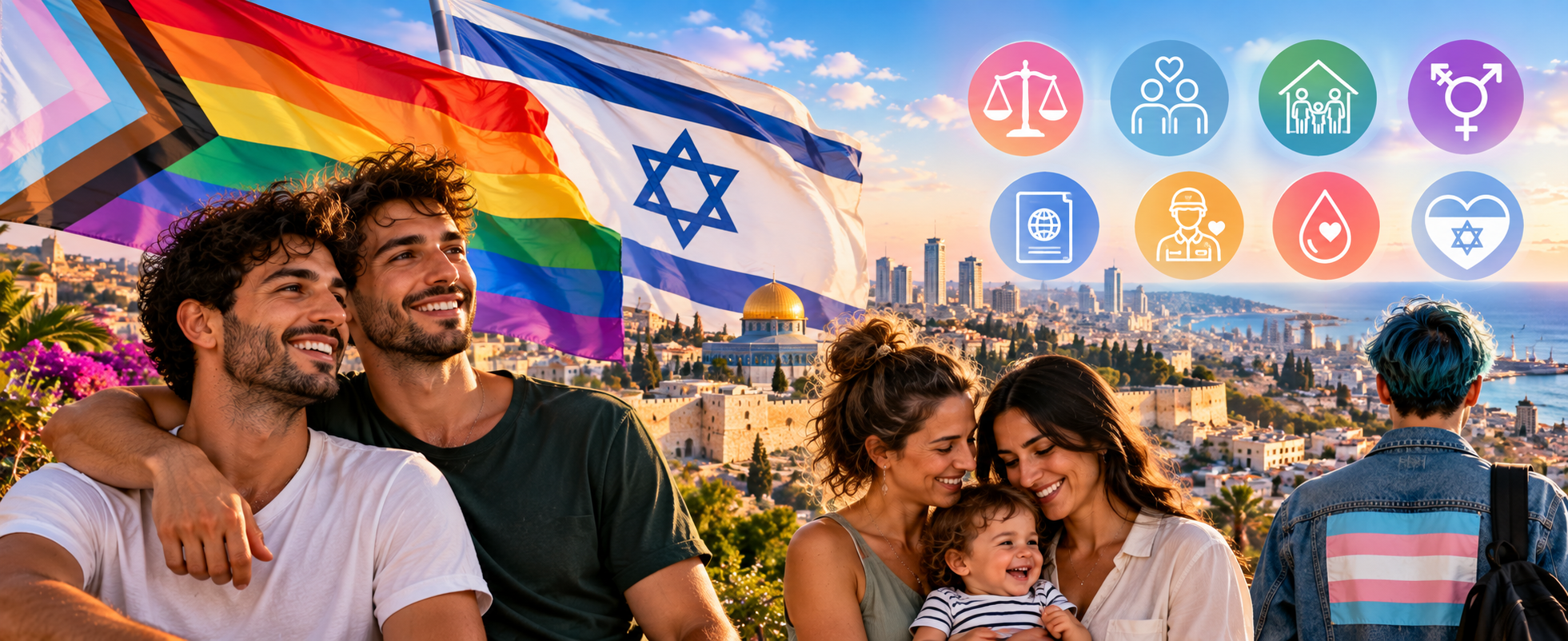
LGBTQ+ Rights in Israel: What You Need to Know in 2026
Israel has a long history of legal changes concerning LGBTQ+ rights. Over the past several decades, many restrictions have been abolished or reduced through legislation passed by the Knesset, rulings of the Supreme Court, and the work of social organizations.
However, the legal status of LGBTQ+ people in Israel cannot be reduced to a simple answer such as “everything is allowed” or “everything is prohibited.” In some areas, legal protection is relatively broad, while in others, restrictions or special procedures still exist.
This is particularly evident in areas such as marriage, parenthood, gender recognition, and protection against discrimination.
Below is an overview of the main rights and legal options. The article is based primarily on materials from LGBT Olim and the updated Wikipedia article on LGBT rights in Israel, as well as, in some cases, official sources from the State of Israel.
Important: Laws, regulations, and court rulings may change. This article is intended for general information and does not constitute a substitute for individual legal advice.
Same-Sex Relationships Are Legal in Israel
The decriminalization of consensual same-sex relations took place in 1988, when the Knesset abolished the relevant criminal prohibition.
However, the actual history is more complex. According to Wikipedia and LGBT Olim, the prohibition on consensual same-sex relations between adults had barely been enforced for many years before that. In 1953, the Attorney General instructed the police not to enforce the relevant law against adults, and in 1963 the Supreme Court upheld this approach. The prohibition was formally abolished by legislation in 1988.
The age of consent for both same-sex and heterosexual relations is 16.
Therefore, consensual same-sex relations between adults are not a criminal offense in Israel today.
Protection Against Discrimination in Employment
One of the important milestones was the development of workplace equality legislation.
Discrimination on the basis of sexual orientation in employment has been prohibited since 1992. In addition, in 1994, the Supreme Court ruled that a same-sex partner of an employee should receive the same partner-related benefits as a partner in a heterosexual relationship.
This has practical implications in a range of areas, including benefits, pension rights, employment conditions, and other benefits provided to employees and their partners.
Wikipedia also notes that protection exists against discrimination based on sexual orientation in the provision of services and goods, as well as broader anti-discrimination mechanisms in various areas. However, specific legal protection based on gender identity is not identical across all areas.
Are Same-Sex Marriages Possible in Israel?
This is one of the most complex areas of Israeli law.
Same-sex marriages cannot be performed in Israel through the religious system, because marriages in Israel are regulated through recognized religious institutions, and there is no general civil marriage system within the country. None of the recognized religious institutions in Israel performs same-sex marriage ceremonies.
However, there is an important distinction between performing a marriage in Israel and registering a marriage performed abroad.
Since 2006, Israel has registered same-sex marriages performed abroad when a valid foreign marriage certificate is presented. The Supreme Court’s decision was based on the obligation to register information appearing on valid foreign documents. The ruling also emphasized the distinction between registration and the question of internal recognition of same-sex marriage as an institution of marriage.
In practice, same-sex marriages registered abroad provide couples with a range of significant civil rights. LGBT Olim notes that such marriages receive equal treatment in various tax, property, and financial matters, even though religious authorities do not recognize them as religious marriages.
For a particular couple, the situation may therefore look like this:
The wedding — abroad.
Marriage registration — in Israel.
Many civil rights — after registration.
What About Couples Who Do Not Want to Marry Abroad?
Israeli law also recognizes certain rights of unmarried couples.
Wikipedia notes that since 1994, same-sex partnerships have been recognized in Israel within the framework of shared family life. Over time, courts and state authorities have expanded various rights in areas such as taxation, inheritance, property, and social security.
This means that the legal status of a couple is not always dependent solely on a marriage certificate.
However, the specific right and the way it can be exercised may vary depending on the circumstances and the documents available.
What About Inheritance and Property Rights?
Here too, there has been a gradual transition from individual rulings to broader recognition of the rights of same-sex partners.
For example, in 2004, the Nazareth District Court recognized the right of a same-sex partner to inherit from a deceased partner, in a manner comparable to the rights of a married spouse.
In addition, legal recognition of same-sex relationships has expanded into tax and property matters. The Attorney General recognized same-sex couples as a legal unit for various financial and practical purposes.
Same-Sex Couples and Adoption
The rights of same-sex couples in the area of parenthood have also gradually been expanded by state institutions and the courts.
In 2005, the Supreme Court ruled that a person could adopt the biological child of their same-sex partner. In 2008, a decision was made allowing joint adoption of children who were not biologically related to either partner.
However, the existence of a legal possibility does not mean that the process is always simple.
LGBT Olim notes that adoption procedures for same-sex couples can be practically complex, and the number of such adoptions has remained limited over the years.
For families in which a child has already been born within a same-sex relationship, there are also other legal mechanisms.
For example, the Ministry of Welfare and Social Affairs describes a procedure for obtaining a parenthood order for the partner of a parent when the child was born during the relationship and there is a shared intention to raise the child as a family.
Two Mothers and Birth Certificate Registration
Another important issue has been the recognition of two women as parents of a child.
In March 2024, the Supreme Court ruled that children born to a same-sex female couple should receive an automatic update and an updated birth certificate reflecting both parents.
At the same time, the Israeli government portal explains that the female partner of the biological mother can obtain legal recognition as a parent by applying to the Family Court and obtaining a parenthood order.
For families, this is a significant example of how legal recognition of parenthood continues to develop through judicial decisions.
Surrogacy for Same-Sex Couples
Significant changes have taken place in this area in recent years.
In January 2022, changes came into effect allowing same-sex couples and single people access to surrogacy procedures in Israel.
The Israeli Ministry of Health currently states that eligibility for the procedure exists for couples or individuals subject to conditions established by law. Among the requirements are Israeli residency of the intended parents and a genetic connection to the child for at least one of them.
For male couples, there are additional rules concerning the use of sperm and the fertilization process. Therefore, even after the legal opening of access, surrogacy remains a complex and regulated process.
IVF and Two Mothers
Significant changes have also taken place in the field of fertility technologies.
According to the updated table on Wikipedia, since 2024 women in same-sex relationships have received additional rights regarding IVF treatment and recognition of both women as parents in applicable circumstances, following a Supreme Court ruling.
For female couples, this represents a significant change in terms of the ability to build a family and establish parental status.
Rights of Transgender People
The development of transgender rights in Israel has followed a somewhat different path.
Since 2015, the Ministry of Health has allowed people to change the legal sex listed on their documents without requiring gender-affirming surgery.
In addition, in 2024 the Knesset approved a law allowing transgender people to remove their former name, or deadname, from their identity card.
Previously, Israeli documents could require former names to be listed even when a person’s gender identity had changed.
However, medical and administrative procedures related to gender transition still involve separate requirements and processes. Wikipedia also notes that there are certain difficulties in obtaining some treatments through the public healthcare system.
Transgender People and Military Service
The IDF has a unique history regarding its treatment of LGBTQ+ soldiers.
In 1993, the IDF officially opened military service to people regardless of sexual orientation. In 1998, sexual orientation ceased to be relevant to questions concerning security clearance, and the special requirements that had previously applied to gay men were abolished.
Today, gay men, lesbians, and bisexual people can serve openly in all IDF units, and discrimination and harassment based on sexual orientation are prohibited.
The IDF also recognizes same-sex couples and certain rights arising from those relationships.
Wikipedia also notes that gender dysphoria in itself is not an automatic reason for exemption from military service, and that in certain cases the military may fund medical procedures related to gender affirmation.
Immigration and the Law of Return
For LGBTQ+ people moving to Israel, family status can have particular significance.
Wikipedia describes several decisions concerning the application of the Law of Return to same-sex partners.
In 2014, the Minister of the Interior officially determined that same-sex Jewish couples married abroad could make Aliyah together even if one of the partners was not Jewish. Both partners can receive citizenship in accordance with the applicable rules.
LGBT Olim also notes that the Law of Return does not contain discrimination based on sexual orientation or gender identity.
For couples moving to Israel together, this issue can have significant practical importance.
Can LGBTQ+ People Serve Openly in the IDF?
Yes.
Today, LGBTQ+ people can serve openly in the Israeli military, and sexual orientation is not grounds for dismissal from military service.
The historical situation was very different, but since the 1990s the military’s policies have changed significantly.
However, the military service of transgender people involves additional administrative and medical considerations, so it cannot be compared entirely with the experience of LGBTQ+ soldiers in general.
What About Blood Donation?
The rules in this area have also gradually changed.
According to the current version of Wikipedia, since October 2021 gay and bisexual men in Israel have been able to donate blood regardless of when they last had sex.
Previously, different restrictions and waiting periods applied.
LGBT Olim gives an earlier date on its website — January 2018 — in connection with the beginning of changes to the Ministry of Health’s policy.
For this current overview, we use the later date shown in Wikipedia’s table — 2021.
What About Conversion Therapy?
Conversion therapy requires a separate explanation.
As early as 2014, the Israeli Ministry of Health stated that such treatments had no scientifically proven effectiveness and could cause harm.
Later, mechanisms were established for dealing with complaints concerning professionals who offered or carried out such treatments.
In February 2022, the Ministry of Health issued a directive prohibiting medical professionals from offering, advertising, or performing “conversion therapy.”
However, it is important to clarify that this does not mean that every form of such activity by every individual is subject to an absolute prohibition. According to official sources and Wikipedia, the main restrictions concern healthcare professionals.
What Does the Public Think?
Legal rights and public attitudes are two different things.
Wikipedia cites several surveys showing differences in Israeli public attitudes toward various issues, particularly same-sex marriage.
For example, according to Pew Research Center data from 2023, 36% of adults in Israel supported legalizing same-sex marriage, while 56% opposed it.
In another 2023 survey conducted by Channel 13 News, 61% of respondents supported equal rights for LGBTQ+ people, while 52% supported same-sex marriage.
These figures should not be combined as though they came from the same study: they involve different questions and different surveys.
They do, however, illustrate that legal status and public attitudes do not always develop at the same pace.
Rights Exist, but Personal Experience Can Be Different
It is important to remember that a legal right is only one part of real life.
For example, the law may prohibit discrimination in employment — but this does not guarantee that an LGBTQ+ person will never encounter prejudice.
Same-sex marriages performed abroad can be registered in Israel — but the ceremony itself still cannot be performed in Israel through the religious system.
Same-sex couples can obtain parental rights — but some procedures may be complex and require an application to a court or the relevant authorities.
A transgender person can change their legal sex without surgery — but the medical and administrative process may involve separate requirements.
Therefore, discussing LGBTQ+ rights in Israel requires more nuance than a simple “allowed / prohibited” table.
Why Is It Important to Know the History of These Rights?
The history of LGBTQ+ rights in Israel is largely a combination of legislative changes and court rulings.
First, the possibility of criminal prosecution was abolished.
Then, protections against discrimination gradually developed.
Later, courts began expanding the rights of same-sex couples in areas such as employment, inheritance, and family life.
Further developments opened possibilities for adoption, registration of marriages performed abroad, surrogacy, and recognition of parenthood.
Another area of development has been the rights of transgender people and legal recognition of gender identity.
Wikipedia notes that organized LGBTQ+ rights activism in Israel has existed since the 1970s. Israel’s oldest LGBTQ+ organization, the Association for LGBTQ Equality in Israel, was founded in 1975.
This demonstrates that the legal status that exists today was not created overnight.
What Does All This Mean for LGBTQ+ People Living in Israel?
In 2026, Israel has a broad system of legal protections and options for LGBTQ+ people.
Same-sex relationships are legal.
Sexual orientation is protected in employment.
Same-sex couples enjoy a range of legal and financial rights.
Same-sex marriages performed abroad can be registered in Israel.
Same-sex couples can adopt children.
Since 2022, same-sex couples have been able to access surrogacy procedures in Israel, subject to the conditions established by law.
Same-sex female couples have gained additional rights regarding IVF and recognition of parenthood.
Transgender people can change their legal sex without being required to undergo surgery.
LGBTQ+ people can serve openly in the IDF.
Healthcare professionals are subject to restrictions concerning conversion therapy.
At the same time, certain issues remain complex, particularly regarding marriage within Israel, certain aspects of parenthood, medical procedures, and differences in the scope of legal protection across different areas.
LGBTQ+ Life in Israel Is About More Than Laws
Knowing your rights is an important part of life, but the LGBTQ+ community is much more than legal documents.
There are people.
There are families.
There are youth groups.
There are community centers.
There are cultural events.
There is Pride.
There are bars, cafés, and other LGBTQ+-friendly places.
There are organizations providing medical, social, and legal assistance.
And there are local communities in cities across the country.
That is why it is important to see legal rights and LGBTQ+ life as part of the same picture.
The law gives a person rights and opportunities.
The community helps them make use of those rights and feel that they are not alone.
Where Can You Learn More?
For a more in-depth look at the subject, it is recommended to read the full Wikipedia article, which includes the history of legislation, court rulings, family rights, gender identity, military service, discrimination, and other topics:
Wikipedia — LGBT Rights in Israel
https://en.wikipedia.org/wiki/LGBT_rights_in_Israel
It is also recommended to consult the practical guide LGBT Olim — LGBT Rights in Israel, especially for people who have recently immigrated to Israel or are considering Aliyah.
GAYIL: Know Your Rights and Find Your Community
Knowing your rights is only one part of LGBTQ+ life.
It is just as important to know where the people, communities, events, and places around you are.
That is what GAYIL is for.
Events. Places. Communities.
From Tel Aviv and Haifa to Netanya, Ramat Gan, Beersheba, Ashdod, Eilat, and other cities across Israel.
Because LGBTQ+ life is not only about laws.
It is about people, encounters, communities, and the freedom to be who you are.
🏳️🌈 Know your rights. Find your community. Find your place.
GAYIL — Live. Connect. Belong.