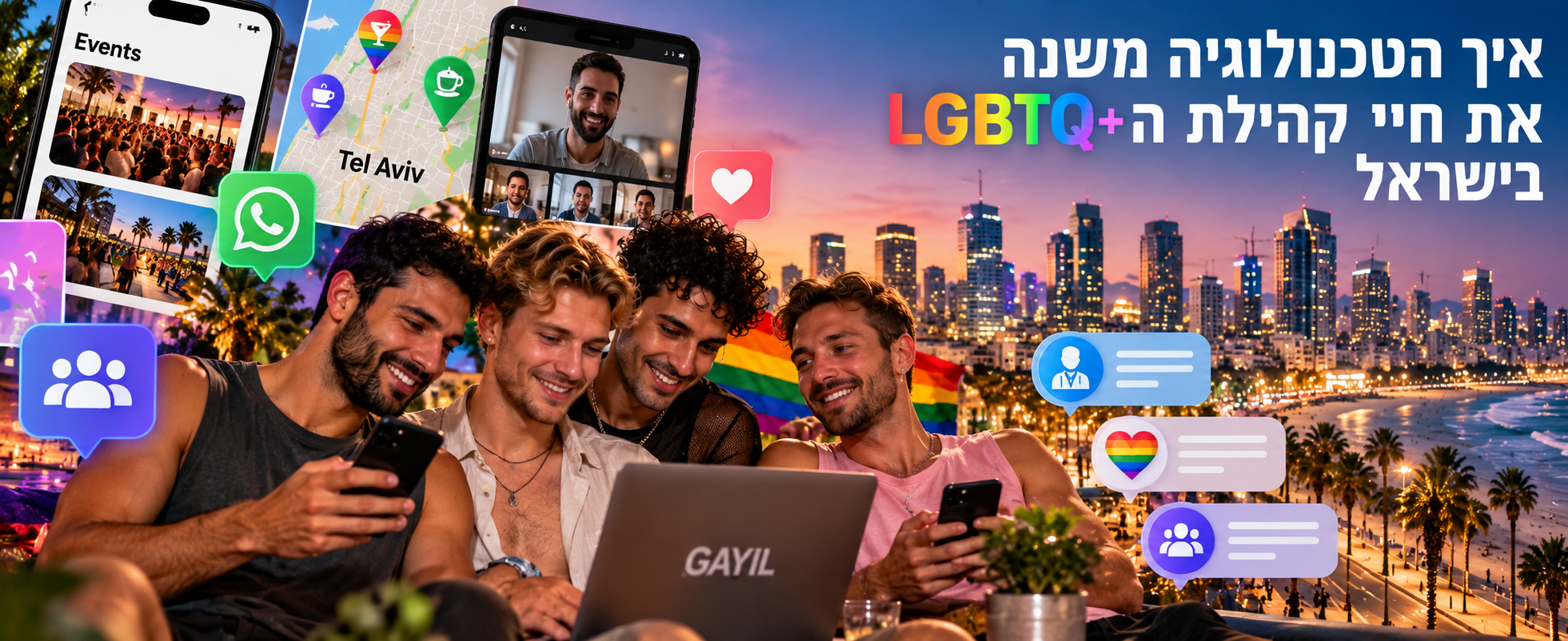
How Technology Is Changing LGBTQ+ Life in Israel
Not so long ago, for many LGBTQ+ people in Israel, finding a community primarily meant meeting people in person: through friends, bars, clubs, community centers, universities, or events. Today, a significant part of that life exists simultaneously in the digital space.
A phone can help someone find an event in another city. WhatsApp can provide access to health advice. Social networks help people connect with others who speak the same language. Online groups allow new immigrants to find their community even before they become comfortable speaking Hebrew.
Technology has not replaced the LGBTQ+ community in Israel. It has made it more accessible and connected people who might otherwise never have met.
From Facebook Groups to an Entire Digital Infrastructure
The history of Israel’s digital LGBTQ+ community began long before TikTok and today’s modern apps.
Research into the Israeli experience has shown that internet forums could become safe spaces for young gay men during the coming-out process. Online environments gave people the opportunity to ask questions, meet others, and talk about sexuality without directly facing the fear of judgment. (Ben-Gurion University Research Portal)
Today, this model has become much more complex.
A person may use several digital spaces at the same time: Instagram for news and cultural content, WhatsApp to communicate with a specific group, Facebook for local communities, Telegram for dedicated channels, Zoom for meetings, and organization websites for reliable information.
The internet has gradually become not just a place for communication, but a kind of infrastructure for LGBTQ+ life.
WhatsApp Has Become Part of the Community
One of the most visible examples is WhatsApp.
In Israel, many community and LGBTQ+ organizations use it not only for ordinary messaging, but also as a channel for support, advice, and event organization.
For example, LGBT Olim uses Facebook groups, WhatsApp groups, and email newsletters for its local communities. The organization connects LGBTQ+ people in Tel Aviv, Jerusalem, Haifa, and Be’er Sheva, and also holds online events. (LGBT Olim)
This is especially important for people who have only recently arrived in Israel.
Imagine someone who has just made aliyah. They may not speak Hebrew well yet and may not know the local venues, organizations, or people. In the past, finding a community could take much longer.
Today, it may be enough to find the right group, ask a question, and make those first connections.
Technology Reduces Distance
Israel is a small country, but LGBTQ+ life is far from limited to Tel Aviv.
Communities exist in Haifa, Jerusalem, Be’er Sheva, Ramat Gan, Kfar Saba, Ra’anana, Petah Tikva, and other cities. LGBT Olim, for example, publishes a list of LGBTQ+ centers across the country. (LGBT Olim)
Digital technologies allow people to participate in community life regardless of whether they live near a major LGBTQ+ center.
A good example is Qulpan, a program by LGBT Olim. These LGBTQ+-friendly Hebrew classes are currently offered online through Zoom, while Facebook groups, WhatsApp, and email are used to stay connected with participants. (LGBT Olim)
For someone living in a smaller city, this can make a real difference.
An online meeting does not require a ninety-minute journey.
And sending a WhatsApp message does not require knowing in advance exactly who to call.
Support Is Now Available Directly From Your Phone
Technology has changed access to support in particularly significant ways.
LGBTQ+ people may face situations that are difficult to discuss in person. It could be a question about identity, family relationships, discrimination, emotional difficulties, or simply the need to talk to someone who understands the context.
The Israeli Aguda provides the “יש עם מי לדבר” (“There Is Someone to Talk To”) service, which operates by phone, WhatsApp, and email. Contact is anonymous and confidential, and the service provides initial emotional support and information. (Aguda 2026)
This represents an important shift: support does not necessarily have to begin at the door of an office.
It can begin with a message:
“Can I ask a question?”
Technology Is Also Changing Sexual Health
Another important area is sexual health.
The Israel AIDS Task Force (הוועד למלחמה באיידס) uses digital channels to provide advice about HIV, other infections, PrEP, and PEP. The organization states that consultations are available by phone and WhatsApp, and its website also mentions contacts through Grindr. (Israel AIDS Task Force)
This can be especially useful when someone is unsure whether they need medical care.
You do not necessarily have to search for a clinic immediately.
You can start by asking a question.
The digital format can also lower the psychological barrier: sometimes it is much easier to send a message than to walk into a medical office and explain a personal situation out loud.
But Digital Freedom Has Another Side
Technology provides more opportunities, but it is not an exclusively positive phenomenon.
Research shows that LGBTQ+ social media can simultaneously create a sense of connection and support while also becoming a source of loneliness, stigma, or psychological strain. In a study involving 610 LGBTQ+ people, more integrated social media use was associated with a stronger sense of connection to the community, while excessive emotional involvement was also associated with negative aspects of well-being. (DOI)
Another study involving 1,735 Israeli LGB people examined discrimination in offline spaces, on Facebook, and on dating platforms. This highlights how closely the physical and digital sides of LGBTQ+ life are intertwined today. (Ben-Gurion University Research Portal)
The online world can be a safe place for one person and a source of pressure for another.
That is why a digital community should not become an obligation to be online all the time.
From Finding People to Finding Events and Places
There is another important change.
In the past, the internet was often used primarily to find people.
Today, more and more digital tools help us find what is happening around us.
An event.
An exhibition.
A movie.
A bar.
A café.
A support group.
An LGBTQ+ center.
A language community.
A city.
This is where platforms like GAYIL have a new role.
The idea is not to replace a real-life community with a virtual one, but to make physical community life easier to navigate.
A person should be able to open a website and quickly understand what is happening today, where they can go, which communities exist nearby, and where LGBTQ+-friendly places are located.
In this case, technology is not the destination.
It is a bridge between a person and real life.
This Is Especially Important Outside Tel Aviv
Digital infrastructure can make LGBTQ+ life more visible in cities where the community is smaller.
Someone in Haifa or Be’er Sheva can discover an event taking place in their city.
A resident of Petah Tikva can find a local community.
A new immigrant can meet people who speak their language.
And someone who is not yet ready to participate actively in offline community life can simply read, watch, and gradually decide what to do next.
Technology allows people to move at their own pace.
What Comes Next?
The next stage of digital LGBTQ+ life may involve not only social networks, but also bringing different kinds of information together.
Events, communities, places, cultural projects, health resources, and educational materials could all exist within one digital space.
This is particularly important in Israel, where LGBTQ+ life exists far beyond one city and one type of audience.
But the main principle remains very simple: technology should help people meet in real life, rather than isolate them from it.
Because community is not an app.
It is not a WhatsApp group.
It is not an Instagram page.
It is not a website.
Community is people.
And technology gives us new ways to find them.
GAYIL — Live. Connect. Belong.
Events. Places. Communities.