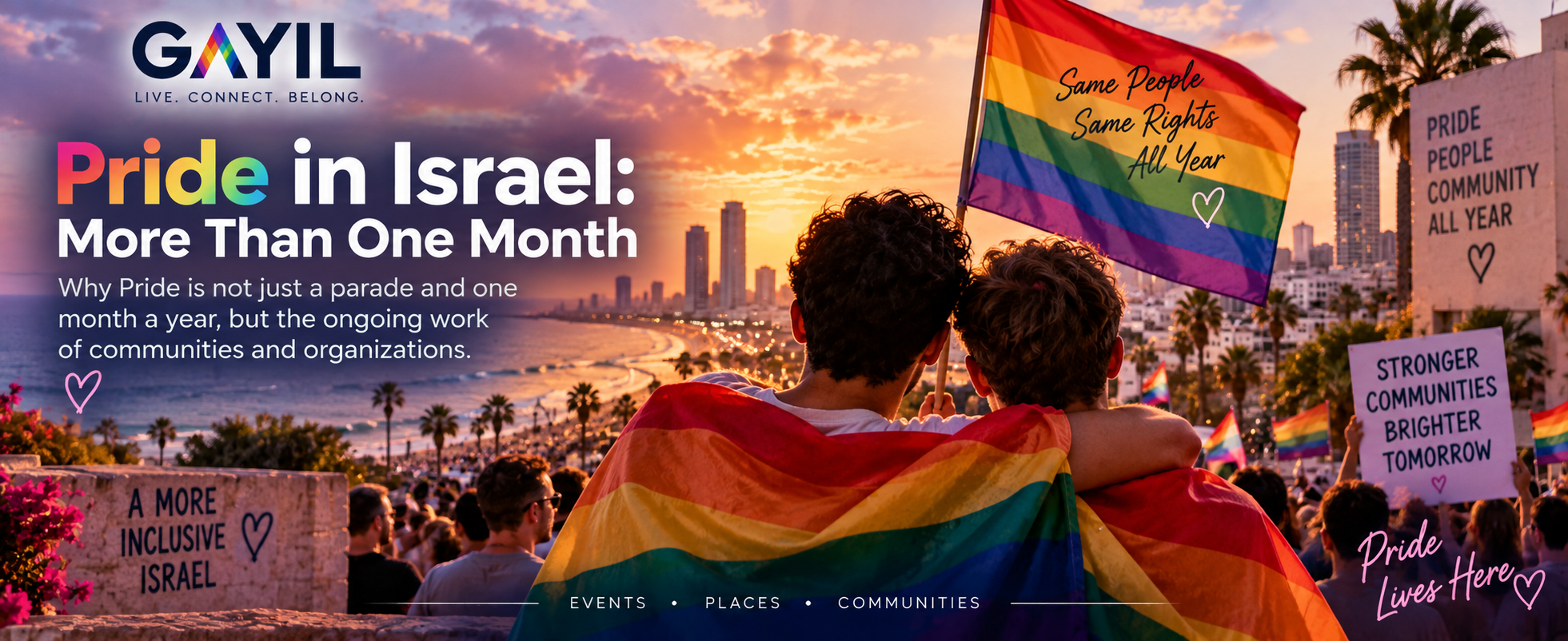
For many people, Pride is associated with parades, rainbow flags, parties, and a few colorful weeks during the year.
In Israel, this is especially visible during the season of major Pride events: cities organize marches, cultural events, gatherings, and parties.
But Pride is much more than what happens in the streets on a single day.
Behind the parade is a much larger LGBTQ+ reality: communities, support groups, youth programs, cultural events, social and medical services, volunteering, education — and simply the opportunity to meet regularly with people who understand your experience.
That everyday work is what keeps a community alive.
Pride Is Not Just a Parade
The parade is the most visible part of Pride.
It brings many people together in one place and makes the LGBTQ+ community visible in public space.
But a parade lasts a few hours. The community exists all year.
After the music stops, the flags come down, and the city returns to its usual routine, the questions remain:
Where can I meet people next week?
Who can I turn to when I need support?
Where can I find a group that feels right for me?
Where can I meet people outside of dating apps?
Where are cultural events happening?
What is happening in my city?
This is where the everyday work of local LGBTQ+ organizations and communities begins.
Communities Are Built Every Day
A good example is the LGBTQ+ Center in Tel Aviv-Yafo.
The center is a space for the LGBTQ+ community in Tel Aviv and the surrounding area, offering not only events but also social, cultural, and professional services throughout the year.
It hosts different groups, social and support programs, cultural events, exhibitions, performances, gatherings, and other activities.
This is exactly the difference between Pride that happens once a year and a community that exists throughout the year.
Pride is also a place you can walk into on an ordinary Tuesday evening.
Young People Are a Central Part of the Community
For teenagers and young adults, finding people with similar experiences can be incredibly meaningful.
In Israel, organizations such as IGY provide spaces and activities for LGBTQ+ youth.
According to the Tel Aviv-Yafo Municipality, IGY operates in more than 40 cities and communities and runs dozens of groups across the country.
This is very different from the idea of “Pride once a year.”
For a young person, the biggest parade is not always the most important thing.
Sometimes what matters more is having a regular meeting.
A place where they can feel:
“I am not alone.”
LGBTQ+ Life Does Not End at 25
Another important part of the community is people of all ages.
The LGBTQ+ community is not made up only of students and young people who go to parties.
There are parents.
There are couples.
There are people who are just beginning to talk about their identity.
There are older adults.
There are transgender and non-binary people.
There are people who live in smaller cities and do not want to travel to Tel Aviv all the time.
That is why real community infrastructure needs to be diverse.
It can include parties and performances, but also support groups, lectures, activities, healthcare services, gatherings for parents, events for different age groups, and places where people can simply spend time together.
Pride Does Not Exist Only in Tel Aviv
One of the most important things to remember about Israel’s LGBTQ+ community is:
It is not only in Tel Aviv.
LGBTQ+ people live throughout the country.
In one place, there may be a local group.
Somewhere else, there may be a small community of friends.
Some cities have social organizations.
Some places host dedicated events.
And in other communities, people are still working to create spaces where they can connect.
That is why local communities matter so much.
Someone from Haifa, Netanya, Be’er Sheva, Ashdod, Eilat, or a small town should not feel that they have to travel to Tel Aviv in order to be part of LGBTQ+ life in Israel.
Pride Is Also Culture
LGBTQ+ culture is much broader than a parade.
Cinema.
Music.
Theater.
Literature.
Drag.
Exhibitions.
Lectures.
Documentaries.
Comedy shows.
And people’s stories.
That is why Pride programs in different cities can include much more than a march — they can also feature a wide range of cultural events.
Culture allows us to talk about complex subjects not only through protest or political statements.
Sometimes a film or a play can tell the story of an LGBTQ+ person in a way that no slogan ever could.
Pride Is Also About Volunteers
A large part of community work never reaches the main stage.
These are the people who:
- organize gatherings
- create local groups
- help new members of the community
- manage social media
- organize events
- translate information
- support people attending for the first time
- work with young people
- create cultural projects
- and simply create spaces where people can meet
Even large community centers and organizations need people who are willing to participate, volunteer, and bring new ideas.
And perhaps that is one of the simplest forms of Pride.
You do not have to stand on a stage.
Sometimes it is enough to help organize one gathering.
Pride Is Also Visibility in Everyday Life
There is a difference between seeing a rainbow for one month each year and feeling that LGBTQ+ people have a real place in society and in everyday life.
It can be a café where a couple feels comfortable sitting together.
A local community that meets regularly.
A youth group.
A cultural event.
A sports group.
A parents’ group.
A place where people can meet others.
It is these small elements that gradually create the larger map of LGBTQ+ life.
So Why Is Pride Month Still Important?
This does not mean that Pride Month is unnecessary.
Quite the opposite.
Pride Month creates a moment when public attention focuses on the LGBTQ+ community.
People take to the streets.
Organizations hold events.
Cities create cultural programs.
New people discover existing communities.
Someone attends a Pride parade for the first time.
And someone else realizes for the first time:
“There are people here like me.”
That is why Pride Month can be a starting point — not an endpoint.
A parade can lead someone to a community.
A cultural event can introduce someone to an organization.
One gathering can turn into a friendship.
And an event discovered by chance can become the first step toward a sense of belonging.
What Happens After Pride?
This may be the most important question.
What happens after Pride Month ends?
The answer is simple:
Life continues.
Gatherings continue.
Communities continue.
Cultural events continue.
Organizations continue their work.
Conversations continue.
Connections continue.
And the search for your place continues.
That is why it is important to know not only when the next Pride parade takes place, but also what is happening in your city throughout the year.
Pride Is Not Just About Watching. It Is About Taking Part.
Participation can look different for everyone.
You can attend an event.
You can join a local community.
You can support an organization.
You can volunteer.
You can organize your own event.
You can tell a friend about a group or gathering.
And sometimes participation begins with something very simple:
finding people with whom you feel comfortable being yourself.
GAYIL: Pride All Year Round
This is one of the reasons GAYIL was created: to make LGBTQ+ life in Israel easier to discover — not only during Pride season.
Events. Places. Communities.
Not just a parade.
Not just June.
Not just Tel Aviv.
On GAYIL, you can discover events, LGBTQ+-friendly places, and communities across Israel — so you can find out what is happening near you and where you can go today, this week, or any other month of the year.
Because the LGBTQ+ community is not an event on a calendar.
It is people, places, gatherings, and stories that exist all year round.
🏳️🌈 Pride is one month. Community is every day.
GAYIL — Live. Connect. Belong.
Events. Places. Communities.