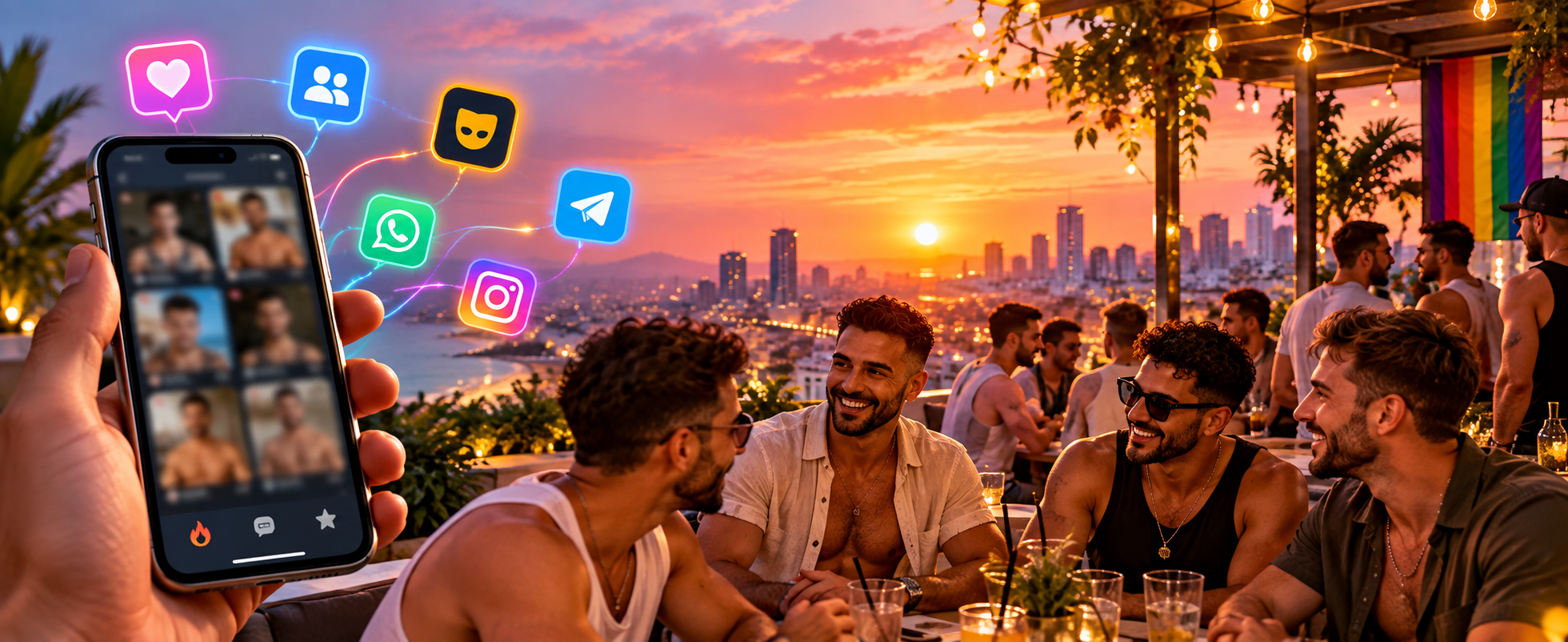
Why Gay Community Still Matters in the Age of Apps
Today, it seems easier than ever to find your people.
There are apps, social networks, WhatsApp and Telegram groups, Instagram, and dozens of other digital spaces. You can be at home, open your phone, and within minutes see what is happening around you.
But this creates a paradox.
We are more connected to each other online than ever before — but that does not always mean we are closer in real life.
That is why gay community and physical spaces where people can meet still matter.
Not because technology is a bad thing.
But because an app cannot always replace the feeling of belonging.
An App Can Show You People. Community Gives You a Sense of Belonging.
Apps are excellent at solving one particular problem: helping us find information and people.
We can discover an event, find an interesting place, join a group, see a new party, or connect with people who share similar interests.
But community is not simply a list of people on a screen.
Community develops when people:
meet;
get to know each other;
come back again;
create traditions;
help one another;
organize things together;
and feel that they are part of something bigger.
That feeling cannot be fully created through an app interface.
Online Is Convenient. But Real-Life Meetings Are Different.
There is a huge difference between reading:
“There is an LGBTQ+ community gathering in your city tonight.”
and actually going there.
In real life, there are voices, faces, emotions, spontaneous conversations, and new connections.
You can arrive alone and leave already knowing a few new people.
You can meet someone you might never have encountered online.
You can discover another group or event by chance.
And those moments can become the beginning of a real community.
Not Everyone Is Looking for a Date
When people talk about gay apps, the conversation often automatically turns to dating.
But LGBTQ+ life is much broader than that.
Not everyone is looking for a relationship today.
Some people want to make new friends.
Some are interested in music.
Others love sports.
Some are looking for cinema, art, or culture.
Some want to find a local group.
And some simply want a place where they can spend an evening in a comfortable environment with other people from the community.
This is where communities become especially important.
Belonging is not only about romance.
What Happens When Apps Become the Main Way We Communicate?
Digital communication has obvious advantages.
It is fast.
Convenient.
Accessible.
And available almost anytime.
But it also has limitations.
In a digital space, it is easy to remain an observer.
You can join a group but never attend a meeting.
You can see dozens of event posts and keep postponing your visit.
You can be surrounded by hundreds of people online and still feel lonely.
That is not necessarily a problem with any particular app.
It is simply one of the characteristics of digital life.
Information creates contact. But repeated real-life meetings create connections.
Why Local Communities Matter So Much
For GAYIL, this is one of the most important ideas.
LGBTQ+ life is not limited to a few major cities.
People live in Haifa, Netanya, Rishon LeZion, Ramat Gan, Petah Tikva, Be’er Sheva, Ashdod, Eilat, and dozens of other cities and communities across Israel.
And every place can have its own story.
Its own people.
Its own groups.
Its own events.
Its own places to meet.
The stronger the local community, the less people feel that they have to travel somewhere else in order to be part of LGBTQ+ life.
Community Starts with Simple Things
Sometimes we think of community as something big.
A large organization.
A large center.
A large Pride event.
But in reality, everything can start much smaller.
One café.
A small group.
A weekly gathering.
A book club.
A workout.
A shared hike.
A movie night.
A small event where ten people simply sit together and talk.
Over time, these small gatherings can become something much bigger.
Places Matter
There is a reason LGBTQ+ centers, bars, cafés, cultural venues, and other community spaces continue to exist in the digital age.
A physical space can create the feeling:
“I belong here.”
You can walk inside.
Sit at a table.
Hear familiar music.
See familiar faces.
Say hello to someone.
Meet someone new.
Or simply be around people with whom you do not have to explain every part of your life.
For some people, this may be a very simple experience.
For others, it can be incredibly meaningful.
Community Connects Generations
In the digital world, we often find ourselves in groups divided by interests, age, or algorithms.
Real communities can bring together people who might never have met otherwise.
A younger person can meet someone who has been part of the LGBTQ+ community for many years.
Someone can share their experience.
Someone else can tell them about a local group.
Another person can help organize a new event.
That is how more than information is passed on.
Experience is passed on.
Stories.
Memory.
Culture.
Community Can Look Different for Everyone
There is no single right model for an LGBTQ+ community.
For one person, it may be a large city organization.
For another, it may be five friends who meet every week in the same place.
For someone else, it may be a sports group.
For another person, it may be a music or cultural space.
For others, it may be a trans community, a parents’ group, a youth organization, or a local city-based group.
And that is perfectly fine.
A community does not have to be large to be real.
What Can You Do If You Don’t Know Where to Find Your Community?
You can start with something simple.
See what events are happening nearby.
Look for a local group.
Visit an LGBTQ+-friendly place.
Go to an event, even if it feels a little scary at first.
Do not wait for the perfect moment.
Many connections begin with a very simple sentence:
“Hi, I’m here for the first time.”
Apps and Communities Don’t Have to Compete
In reality, the question is not which is better — the internet or real life.
We need both.
Apps help us find information.
Social networks help spread news.
Online groups help us stay connected.
Maps help us discover new places.
And real-life meetings turn all of that into an experience.
You can discover an event online.
Go to it.
Meet people.
Join a group afterward.
And eventually even help organize the next gathering.
That is how a digital connection becomes a real community.
And That’s Exactly Why GAYIL Exists
GAYIL was not created as another dating app.
Its purpose is different:
to help people discover LGBTQ+ life around them.
Events.
Places.
Communities.
All of these exist not only online and not only during a particular time of the year.
Sometimes the group that is right for you is in the next city.
Sometimes an interesting event is happening just a few kilometers from home.
And sometimes a place you have walked past dozens of times turns out to be LGBTQ+-friendly.
Often, the problem is not that community does not exist.
The problem is that it is hard to find.
Community Still Matters
We live in a digital age.
We are used to searching for everything through a screen.
But people still need other people.
We need conversations.
We need friends.
We need places.
We need shared interests.
We need memories that cannot simply be paused or closed with a swipe.
That is why gay community is not disappearing in the age of apps.
Quite the opposite.
Digital tools can help make community more accessible.
But in the end, community is not an app.
It is people who show up. Meet. Come back. And create something together.
🏳️🌈 Finding people online is easy. Finding your community is what matters more.
GAYIL — Live. Connect. Belong.
Events. Places. Communities.